Is It a Plantar Wart or Just a Callus? How to Tell the Difference
(and Stop it from Coming Back)
You notice a hard, thickened patch of skin on the bottom of your foot. Assuming it’s just a stubborn callus from your new running shoes, you grab a pumice stone or a foot file in the shower to scrub it away. But instead of smoothing out, it hurts, bleeds slightly, and within a few weeks, it comes back bigger…and maybe it even brought a few “friends” along with it.
If this sounds familiar, you are likely dealing with a classic case of mistaken identity. You don’t have a callus; you have a Plantar Wart.
Because these two foot conditions look incredibly similar to the untrained eye, patients frequently misdiagnose themselves. In this blog, Foot & Ankle Center of Ohio will explain exactly what’s on your foot and what you can do about it.
The Diagnostic Guide: Wart vs. Callus
While both conditions are presented as thick, hard layers of skin, their biological causes are different.
- A callus is your body’s mechanical response to friction.
- A plantar wart is a viral infection caused by the Human Papillomavirus (HPV).
If you are trying to figure out what is on your foot, look for these three distinct clues:
1. The “Pinch” vs. “Press” Test
This is the most reliable at-home test.
- If you push directly down on a callus, it will usually feel tender.
- However, if you squeeze the lesion from the sides (pinching it) and feel a sharp, piercing pain, it is almost certainly a plantar wart.
2. The “Black Dots”
People often refer to the “seeds” of a wart.
- Warts don’t have seeds. Because a wart is an active viral infection, it requires a blood supply.
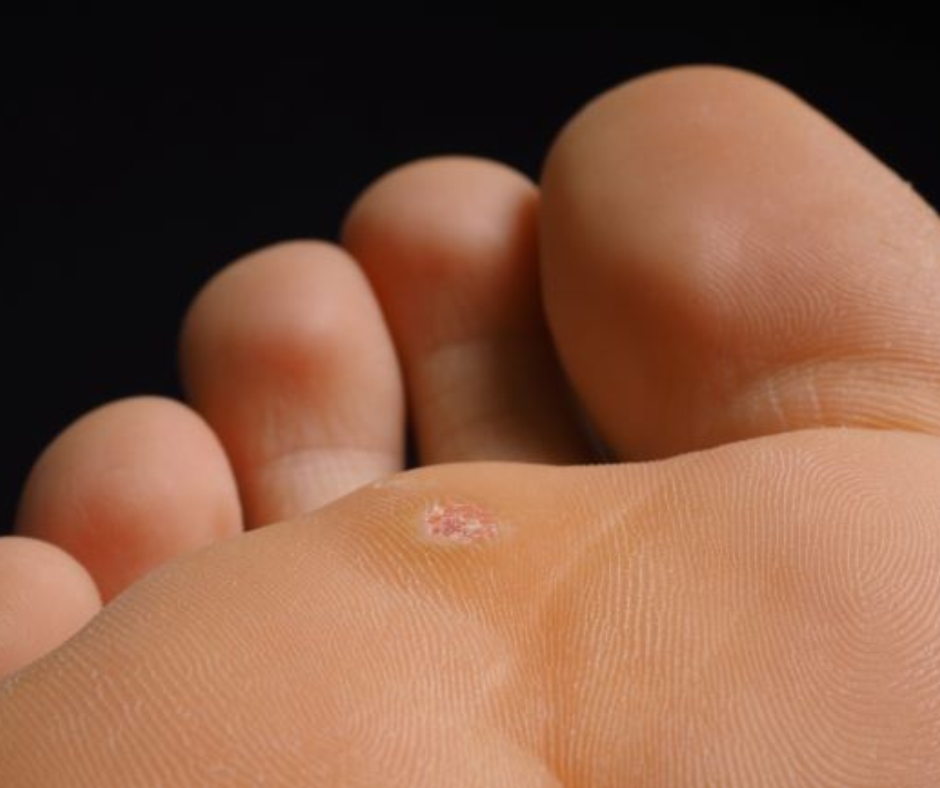
- Those tiny black dots you see in the center of the bump are dried capillary blood vessels.
- Calluses, on the other hand, are just dead skin cells and will never have these black dots.
3. The Skin Lines (Striae)
Look closely at the natural fingerprint-like lines on the bottom of your foot.
- If you have a callus, those skin lines will continue across the top of the thickened skin.
- If you have a wart, the viral growth will disrupt those lines, forcing them to bend and go around the lesion.
The Danger of DIY: Don’t File a Wart!
If you have a callus, using a foot file is perfectly fine. But if you use a file, pumice stone, or chemical peel on a plantar wart, you are actively spreading the HPV virus.
- When you file a wart, you create micro-tears in the surrounding healthy skin and introduce the viral cells directly into those cuts.
- This is why misdiagnosing a wart at home often leads to “mosaic warts,” a large cluster of satellite warts that spread across the sole.
The Ultimate Defense Against Recurrence: SWIFT® Therapy
If you’ve confirmed you have a plantar wart, your next question is likely:
“How do I get rid of it permanently?”
Historically, treating warts was a frustrating cycle. Doctors would use freezing (cryotherapy) or harsh acids to burn off the top layer of the skin. But because those methods didn’t kill the underlying HPV virus, the wart would frequently grow right back.
Today, we use SWIFT® Microwave Therapy to stop the cycle of recurrence.
- Instead of burning the surface of the skin, SWIFT uses targeted, low-dose microwave energy to heat the infected tissue.
- This heat “uncloaks” the HPV virus, making it visible to your body’s immune system.
- By alerting your immune system to the virus, your body creates antibodies to fight it off from the inside out.
- Once your immune system learns how to defeat that specific strain of HPV, the chances of the wart ever returning drop to less than 1%.
Stop Guessing and Start Healing
If you are tired of playing a guessing game with your foot health, it’s time to get a professional diagnosis. Stop scrubbing, stop freezing, and let your immune system do the work.
Contact our office today to schedule a consultation. We will evaluate your foot, give you a definitive answer, and create a targeted treatment plan to get you back to walking comfortably.